
Stress is strain on a person caused by the feeling that demands on them will greatly challenge or even exceed their personal abilities and resources to meet them.
Individuals feel stress physically, mentally and/or emotionally, and it results in anxiety, exhaustion, frustration and anger. While stress can be a motivating force compelling a person to achieve success, when it becomes overwhelming, stress becomes debilitating.
Stress managing or stress management is the process of taking steps to counteract the causes and effects of stress in daily life when you cannot eliminate it. It involves a range of techniques used to identify and counteract the causes of stress. Learning stress management allows students to improve time management to reduce time stress, learn relaxation techniques, develop coping strategies, build tolerance or resilience to stress and seek professional help when needed.
The American Institute of Stress (AIS) calls stress an “epidemic” among college students, noting that 80% of students experience frequent stress. And 34% of college students report being depressed, which can result from overwhelming stress and a lack of stress management skills. The AIS reports that students, “are not necessarily given healthy coping methods for managing stress.”
What Are the Causes of College Stress?
These are the major reasons why 80% of college students report experiencing significant stress during their college careers:

- Academic Pressure: Students experience pressure from personal and parental expectations about academic performance, difficult classwork, exams and projects, and pressure to get good grades each semester and maintain a GPA that will allow them to obtain their academic goals.
- Time Management Challenges: College students must find a proper balance for time demands that often include classes and labs, homework and/or practice, study for exams, employment and other personal responsibilities, internships, a social life and sleep.
- Financial Stress: While 85.5% of college students receive some form of student financial aid, many feel pressure from the cost of attending college including tuition and fees, housing and other living expenses, loan payments, and transportation.
- Social Challenges: Attending college involves making new relationships, maintaining existing relationships sometimes at a distance, handling peer pressure challenges such as using drugs and alcohol, having exposure to people from diverse cultural backgrounds and dealing with homesickness if the student is far from home.
- Lifestyle Changes: Many college students are independent and on their own for the first time and must adapt to managing their own schedule, making significant life choices, and managing new living arrangements like a dorm or apartment.
- Mental Health Issues: Students with preexisting mental health conditions such as anxiety, depression and bipolar disorder may find that college pressures make their issues more difficult to manage.
- Concerns About Career: Students feel pressure to choose the right major, maintain a high GPA, obtain the best internships in order to be in a position to succeed in their future career.
- General Concerns About the Future: Students are often anxious about life after college including being hired for a job in their field, paying off student loans, relocating for a job and becoming detached from their social and support networks.
What Are the Strategies for Stress Management for College Students?
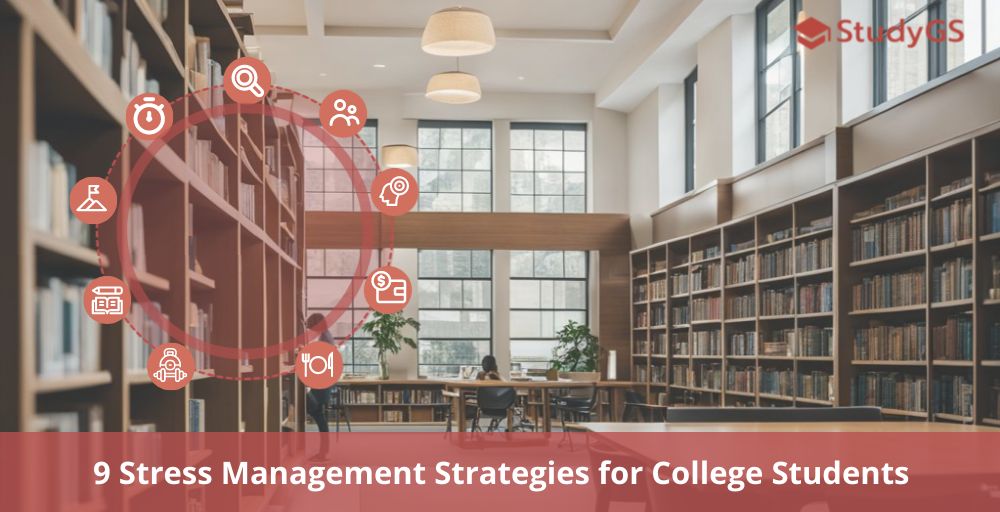
These stress management strategies are proven to reduce the negative impact of stress on college students.
- Identify the stressors
- Develop time management skills
- Set realistic goals
- Incorporate study techniques
- Exercise regularly
- Eat well
- Use financial management skills
- Practice mindfulness
- Seek professional help

Identify Stressors
Each student has a unique experience with stress, and the first step in stress management is to identify which stressors are producing your stress, so that you can effectively address them with a stress management plan tailored to your needs.
Internal and external stressors exist. Examples of internal stressors are personal academic expectations, concerns about their future career, and mental health challenges that were preexisting or that developed during college.
External stressors for college students include academic pressure caused by taking difficult courses or a heavy class load, financial stress, balancing demands that might include a part-time job, and lifestyle and social changes that come with going to college.
Develop Time Management Skills
Effective time management skills help reduce procrastinating and give students a sense of being in control of their schedule, which increases their confidence, encourages a positive mental attitude, and reduces stress. A review of studies on stress and time management, found that, “stress levels are decreased among students that manage their time well.”
Time management skills are tools students use to allot time for class, review, studying and other learning tasks that best prepare them for academic success.
Time management skills that use time well and reduce stress include scheduling time before lecture to read the sections in the textbook that will be covered, reviewing notes immediately after the lecture, getting an early start on papers and projects, and building time into the schedule for peer study groups, getting assistance from instructors, and non-academic activities like de-stressing and relaxing, exercising and getting sufficient sleep.
Set Realistic Goals
Setting goals that are realistic gives students a path to follow in order to achieve success in school and beyond. When you meet goals, stress is relieved. These goals are about more than just excellent final grades in a class but about the preparation, study and review steps needed to get to that level of performance.
Realistic goals are SMART goals, meaning that they are specific (S), measurable (m), achievable (A), relevant (R) and Time-bound (T) which means a deadline is set for achieving them.
When goals are too large, they are unrealistic and cause stress because you might not be able to achieve them. Therefore, break down large goals into smaller, measurable and achievable steps, each with its own time deadline.
Adjust goals when necessary to make them realistic and prevent stress. Goals about deadlines, how much time can be spent studying or writing a paper, and even sometimes the grade that is achievable must be altered to make them realistic.
Incorporate Study Techniques
Good study techniques are essential to lowering stress and achieving academic success. They begin from the first day of the semester, not just when test time approaches. When practiced, and you have a good grasp of the material covered in the class, good study techniques lower stress and boost confidence, giving you an “I can do this” attitude.
Incorporating proven study habits include following the study cycle of preview class material, attending the lecture or lab, reviewing your notes from class soon after it ends, studying for quizzes and tests, and afterward, assessing.
Exercise Regularly
Exercising 2-5 times per week has demonstrable benefits for college students including easing stress. It is essential to meeting the rigorous demands of getting a college education. Exercise also leads to better sleep, and regularly getting enough sleep is essential for students.
Getting good exercise produces endorphins which are “feel good” hormones leading to better mental health that helps reduce the stress felt by eight in 10 (80%) college students. A study on physical activity and stress management published on Sage Journals that showed, “Student physical activity is associated with lower stress. This study examined associations between physical activity and stress management behaviors among students (18-35 years).”
Eat Well
There is a relationship between eating a healthy diet and having lower levels of stress. On the other hand, a study on stress levels and eating behaviors “Students with high perceived stress levels exhibited increased unhealthy dietary behaviors.”
Eating good foods improves your mental health, boosts your mood and helps prevent anxiety about school.
Eating well for college students includes consuming complex carbohydrates, lean proteins, plenty of vegetables and some fruit while avoiding sugary foods and processed foods.
You will also have an increased, consistent energy level with foods with low glycemic indexes rather than up-and-down levels caused by a poor diet that includes too much sugar, disrupts study and sleep and increases stressful feelings.
Financial Management
Financial stress causes anxiety and makes it more difficult for college students to focus on their studies. Good financial management helps to reduce stress.
For college students, good monetary management starts with filling out the FAFSA application for financial aid. This is the first step in receiving financial student aid such as a Pell Grant.
Once enrolled, students can practice good fiscal management in several ways. The first is to maximize the number of credit hours you can take using your school’s flat rate tuition, if it has it. This reduces the cost per credit hour of your education.
Additional financial management tips for college students include tracking your spending and cash flow to see where your money is going, then setting a budget and sticking to it, only using credit cards if they are paid off monthly to prevent debt and finance charges, save up for unexpected expenses, make student loan and other loan payments on time, buy used materials such as textbooks when available and take a part-time job or paid internship if available and time allows.
Practice Mindfulness
Practicing mindfulness means to be aware of the present moment, paying attention on purpose, without stressing over the past or the future.
According to a research paper published in Frontiers in Psychology, “A growing body of research suggests that higher levels of mindfulness are associated with lower levels of perceived stress, anxiety symptoms, depressive symptoms, suicidal ideation, and pain.”
Additional advantages of practicing mindfulness while in college include better regulation of emotions – fewer ups and downs emotionally, less incidence of depression, increased resilience to challenges and setbacks, and greater self-awareness as you consider the best career path starting with which major to choose and classes to take.
Other benefits of mindfulness are that it increases concentration and improves your attitude toward studying while building confidence, all of which produce better academic performance – a higher GPA.
Seek Professional Help
Getting professional help with stress is critical stress when it is constant, overwhelming, and becoming too difficult to cope with, causing depression, negatively impacting grades or producing thoughts of self-harm.
Physical symptoms of overwhelming stress that indicate the student likely needs professional help include stomach issues, lack of appetite, eating to cope, frequent headaches, and changes in sleep – not being able to sleep or using sleep as an escape.
Emotional symptoms of stress that might require professional assistance include sever anxiety, depression, persistent worry, panic attacks or thoughts of suicide.
Most colleges and universities provide mental health services to their students including emergency services. Options include counseling and therapy, psychiatric services, support groups, peer-to-peer counseling, prevention programs and referral services. These options might be online or in person.
What Are the Effects of Stress on College Students?
Stress has many effects on college students that impact their academic performance.
Positively, manageable low-level stress can be a motivator for students to get them to work smarter and harder to achieve their academic goals, practice excellent time management and follow good study habits.
The majority of effects of stress on college students are negative. Stress reduces cognitive abilities essential for success such as focus, concentration, deep learning, critical thinking, decision-making, retention and memory.
Stress can have negative physical impact such as the student getting too little or too much sleep, feeling fatigued and having muscle pain, experiencing a loss of appetite or overeating, having chest or stomach pain, and suffering from high blood pressure.
Emotional impacts of stress on college students include anxiety, depression, and a worsening of existing mental health issues.
Related effects of stress on students include decreased enjoyment of life, feelings of burnout and hopelessness, withdrawing from social interaction and relationships, and diminished care for one’s well-being.
How College Stress Is Related to Procrastination
Procrastination is the habit of putting off necessary decisions or tasks that seem too hard to complete in favor of doing something easier or fun and pleasurable.
Stress and procrastination can become a cycle for college students. Stress leads to procrastination, which increases stress and the desire to put off tasks that seem more overwhelming. While procrastination momentarily relieves stress by replacing it with something enjoyable, the ultimate result of continued procrastination is a higher stress level.
The combination of stress and procrastination results in missing deadlines, failing to study for quizzes and exams, and harmful personal habits.
When to Choose Part Time in College to Lower Your Stress
When stress is negatively impacting academic performance or their lives in general, full-time college students should consider part-time status to ease the stress.
Consider changing to part time when taking a full course load is producing a stress level that contributes to poor grades or harm to your physical or mental health. And when taking too many classes impedes your ability to fulfill other responsibilities such as caring for family or holding a job, then taking a reduced number of credits is a solution worth considering.
What Is the Minimum Number of Credits for Full Time Student Status?
Most colleges define a full-time student as a student taking at least 12 credit hours in a semester. Schools give part-time status to students taking less than 12 credit hours in a semester.
What Resources Are Available for Students Seeking Assistance in Stress Management?
A range of school and community resources are available to students pursuing help with stress management.
On campus, stress management assistance includes peer to peer counseling and support groups, in-person and online stress management workshops and resources, professional counseling and psychological services, faculty tutoring, academic and career advising and guidance, and fitness and recreational facilities.
In the local community, college students can find help with stress management from community mental health services, private psychological and psychiatric services, and from religious organizations.